Category: Make Money

All post relating to ways to make money

  • How to Make Money on Instagram Selling Digital Products (Without a Large Following)

    Follower count is not the variable that determines whether your digital product sells on Instagram. Here is what actually does.


    There is a persistent myth in the digital product world that goes something like this: build your Instagram following first, then monetize it later.

    That sequence made sense five years ago when Instagram was purely a follower-driven platform where reach meant everything. It does not reflect how Instagram actually functions as a sales channel today.

    Small accounts with 400 followers sell digital products every single day. Not because of any platform feature or follower threshold they crossed.

    Because they understood something most creators spend months figuring out:

    Instagram is not a popularity contest. It is a trust-building machine.

    And trust, not follower count, is what converts a browser into a buyer.

    If you have been waiting to sell digital products on Instagram until your account is “big enough,” this article is here to tell you that you have been waiting for the wrong thing.

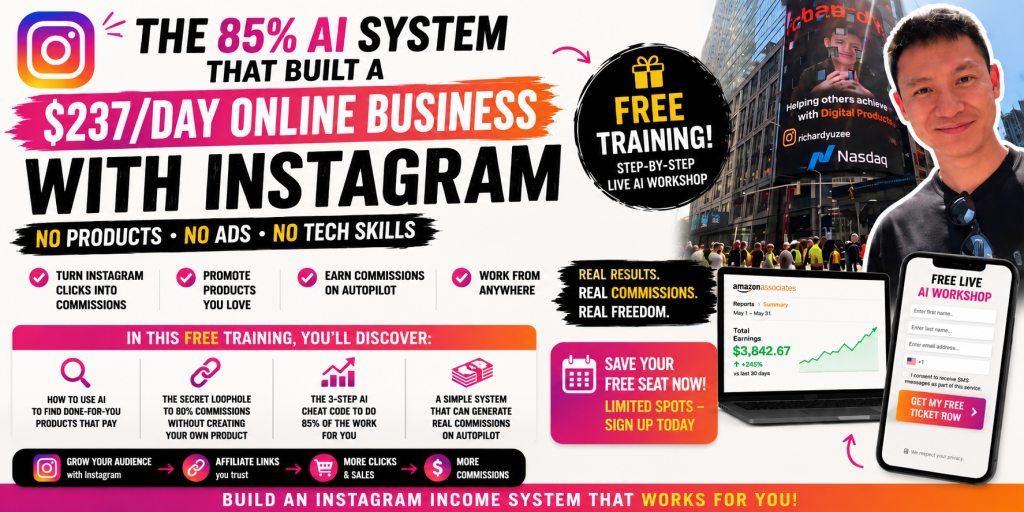
    Before we get into the complete strategy, my mentor Richard Yu has put together a free masterclass that shows exactly how people are using AI and Instagram to sell digital products and generate real passive income, starting from accounts with zero existing followers.
    ๐Ÿ‘‰ Get free access HERE

    Save your spot now, then keep reading for the complete guide.


    Why a Small Instagram Account Can Outsell a Large One

    A 50,000-follower account that built its audience through giveaways, viral memes, or broad entertainment content has a problem most creators do not talk about openly: that audience did not follow them because of any specific problem they solve.

    They followed for entertainment, and entertainment audiences do not convert into buyers at meaningful rates.

    A 600-follower account built around a specific niche, budgeting for single parents, social media strategy for handmade sellers, home organization for small apartments, has something far more valuable than follower volume. It has audience alignment.

    Every follower arrived because the content directly addressed something they are actively dealing with.

    When a product appears that solves that same problem, the conversion rate reflects the quality of that alignment, not the size of the audience.

    This is the foundation everything else in this guide is built on. Build for alignment first. Volume comes as a byproduct.


    Step 1: Choose a Digital Product That Solves One Specific Problem

    The fastest path to your first Instagram digital product sale begins with a market validation step that most creators skip entirely.

    Before you build anything, go to Etsy and search the product category you are considering. Filter by bestsellers and read the reviews, especially the one and two star ones.

    The complaints in those reviews are a direct window into what the market wants but is not currently getting.

    Build the version that solves what the bestsellers failed to deliver.

    The product categories that sell most consistently through Instagram content include:

    • finance and budgeting templates,
    • social media content kits and caption packs,
    • printable planners and journals,
    • beginner guides for specific life transitions,
    • AI prompt packs for defined use cases,
    • and niche-specific ebooks that deliver one clear outcome.

    Specificity is your competitive edge as a small account. A generic budgeting template competes with thousands of listings. A budgeting template designed specifically for freelancers with irregular monthly income competes with almost none and speaks directly to a buyer who feels immediately understood.

    That feeling of being understood is what converts browsers into buyers faster than any follower count could.


    Step 2: Get Your Product Live in Days, Not Months

    AI has collapsed the production timeline for digital products in a way that genuinely changes what is possible for a solo creator.

    Use AI to outline the structure of your product, draft the written content, write the product description and title, and generate the promotional copy that will drive traffic to your listing.

    Canva handles the visual design and mock-up images that make your product look professional and immediately desirable on Instagram.

    A focused beginner using AI assistance can build, design, and list a professional digital product in a single weekend. Not a perfect product. A genuinely useful one. Real buyer feedback after your first sales tells you what to refine.

    Waiting for perfection before listing costs you the market data that only real transactions can provide.

    Host your product on Gumroad, Stan Store, or Payhip. All three collect payment automatically, deliver the product instantly, and give you a clean link to put in your Instagram bio.

    No complex setup. No weeks of approval waiting. A link in your bio that works from day one.


    Step 3: Optimize Your Profile as a Conversion Tool

    Your Instagram profile is the first thing a potential buyer sees after discovering your content. It has one job: turn curiosity into a click.

    Your bio needs to communicate three things in two sentences or less. Who you help. What problem you solve. What to do next. One link. One call to action. Nothing else.

    Your profile photo and username should signal your niche clearly enough that a new visitor understands your content focus within seconds.

    A niche-specific account that feels purposeful attracts the right followers.

    A generic account that could be about anything attracts nobody who will ever buy anything.

    The link in your bio should point directly to your product, or to a simple page that showcases your products with clean descriptions and prices.

    Every extra click between your bio and the checkout page is a point where a potential buyer decides not to continue.


    Step 4: Build Content That Pre-Sells Before You Ever Mention the Product

    This is the step that separates Instagram accounts with products from Instagram accounts that sell products. The content you publish before the product promotion does the majority of the sales work.

    The content rhythm that converts small audiences into buyers follows a consistent three-part pattern.

    Educational posts teach your audience something genuinely useful about the problem your product solves. This is the majority of what you publish.

    It builds the expertise perception and the relationship trust that makes a product recommendation feel like help rather than a sales pitch.

    AI generates this content at scale, drafting a full month of educational posts in a single afternoon session with the right workflow.

    Proof posts show results, share what you are learning, demonstrate the product in use through mock-up images, or share testimonials from early buyers. This layer converts trust into credibility and makes the product feel real and valuable before anyone purchases.

    Offer posts make a clear, direct call to action pointing to your product.

    This is the smallest portion of your content volume, roughly one in every eight to ten posts, and it converts at a significantly higher rate when the educational and proof content has already done the trust-building work.

    Most small accounts that fail to sell digital products on Instagram are posting too many offer posts and not enough educational ones. Reverse that ratio and the results change almost immediately.


    Step 5: Use AI to Maintain Consistency Without Burning Out

    Consistency is the variable that determines whether your digital product income grows or stalls. A content strategy that requires four hours of daily effort will not survive contact with real life for more than a few weeks.

    AI makes consistency achievable for a solo creator managing a digital product business alongside everything else their life requires.

    Captions, hooks, carousel scripts, story sequences, promotional copy, and content calendar planning are all generated in a fraction of the time manual creation requires.

    What used to take a full production day now takes a focused 90-minute session with the right workflow.

    The content library you build over time compounds in its reach and impact.

    Posts from three months ago continue attracting new followers and driving product sales without any additional effort.

    That compounding is what transforms Instagram from a promotional channel into a passive income asset.


    The Complete System That Makes This Work

    Choosing the right product, setting up your profile for conversion, and building the right content rhythm are all learnable steps.

    What makes them work together as a system that generates consistent digital product income is the specific AI workflow that holds everything together without requiring more time than you actually have.

    Richard’s free masterclass walks through that complete system, from product selection to AI content creation to the conversion architecture that turns Instagram followers into digital product buyers.

    You will see the exact tools, the exact workflow, and the exact strategy that people with small accounts are using to generate real product income right now.

    Follower count is a lagging indicator. Trust, specificity, and the right system are the leading ones. Richard shows you exactly how to build all three.

    ๐Ÿ‘‰ Access Richard’s free masterclass HERE

    Register now, work through it at your own pace, and walk away with a complete system for selling digital products on Instagram starting from wherever your account is right now.


    This post contains affiliate links. I may earn a commission if you register through my link, at no extra cost to you.


  • How to Make Money From Home

    Surveys and selling old furniture will cover a short-term gap. But this guide is for people who want something bigger with the opportunity to grow.


    There is a version of “making money from home” that most articles describe, and a version that actually changes your financial situation.

    • The first version involves tasks.
    • Completing surveys.
    • Scanning receipts.
    • Selling items around the house.
    • Renting out a spare room.

    These all work in the narrow sense that they generate some cash.

    The ceiling is low, the income stops the moment you stop, and twelve months from now you are in exactly the same place you started, just with a slightly emptier closet.

    The second version involves building.

    • Creating content that keeps earning after you publish it.
    • Building products that sell while you sleep.
    • Developing skills that increase in value over time and compound into income that is not dependent on how many hours you physically show up to produce it.

    This article is about the second version.

    Every strategy below can be built from home, started without significant upfront investment, and scaled using AI tools that have completely changed what a single person can produce and distribute on their own.

    Before we get into the full breakdown, my mentor Richard Yu has put together a free masterclass that shows exactly how people are using AI and Instagram to build real, compounding income from home starting from zero.

    ๐Ÿ‘‰ Get free access HERE

    Save your spot now, then keep reading for the complete guide.


    The Question That Changes How You Approach This

    Before any strategy, one honest question worth sitting with.

    Are you looking to cover a specific short-term gap in your monthly budget, or are you trying to build something that changes your financial situation permanently?

    Both are valid. They require completely different approaches.

    Short-term gap: sell things, take on gig work, offer a quick service. Fast income. Low ceiling. Stops when you stop.

    Permanent change: build an asset-based income stream that earns after the initial work is complete. Slower to start. Compounds significantly over time. The effort you invest in month one earns again in month twelve without you repeating it.

    Every strategy below is designed for the second goal. Not because the first goal is not real, but because solving the first goal permanently requires building toward the second one.


    How to Make Money From Home That Actually Grows

    High-Ticket Affiliate Marketing Through Instagram

    This is the home-based income model with the most favorable combination of low startup cost, fast time to first income, and high long-term ceiling for people starting from zero.

    You create content on Instagram around a specific niche, recommend premium products and services through affiliate links, and earn significant commissions per sale, typically $200 to $1,000 or more, without creating a product, handling customer service, or leaving your home for a single minute of it.

    The difference between standard affiliate marketing and high-ticket affiliate marketing is the math. Earning $2 per sale requires hundreds of conversions to generate meaningful monthly income. Earning $300 per sale requires a handful.

    For someone building an audience from zero at home with limited available hours, the high-ticket model is the only one where the math makes sense before you have massive traffic.

    AI writes your captions, generates your content ideas, and helps you build a month of Instagram posts in a single focused afternoon.

    You direct the strategy from home. The commissions compound as the content library grows.

    Selling Digital Products

    Digital products are the most genuinely home-based income model available.

    • Creation happens at home.
    • Marketing happens at home.
    • Fulfillment happens automatically without your involvement in each transaction.
    • The entire business runs from a laptop on your kitchen table.

    Create a template, a guide, a planner, or a mini-course once. Upload it to a platform that handles payment and delivery automatically.

    Every sale that follows generates income without you processing it manually.

    AI builds the product, writes the sales copy, and generates the promotional content. Canva handles the visual design. The platform handles the customer experience.

    Your job is the strategy and the niche knowledge that makes the product genuinely worth buying.

    Freelance Copywriting

    If you can write clearly and understand what motivates people to make decisions, copywriting is one of the highest hourly rate home-based income opportunities available without a formal credential or degree.

    Businesses pay serious money for sales pages, email sequences, landing pages, and ad copy that converts readers into buyers. The work is entirely remote. The rates improve as your portfolio grows.

    Experienced freelance copywriters earn six figures working part-time hours from their living room.

    AI drafts. You apply the strategic judgment that turns a draft into something that earns real results for clients. That combination is more valuable than either component alone.

    Social Media Management

    Small business owners need consistent, professional Instagram presence and most of them lack either the time or the skill to create it.

    If you understand content strategy and can use AI tools to produce content efficiently, you can manage several client accounts simultaneously from home and earn recurring monthly income from each relationship.

    One client at $750 per month. Two. Three. Predictable, renewable income that does not require you to re-earn it from scratch each month.

    Virtual Assistant Services

    Organized, reliable people who can manage inboxes, research topics, schedule content, and keep online businesses running smoothly are in consistent high demand from online entrepreneurs who need support but cannot justify hiring full-time staff.

    The work is entirely remote and asynchronous. You work on your schedule from your home.

    AI makes you significantly more efficient, allowing you to serve more clients in fewer hours than manual work alone would allow.

    Blogging With Affiliate and Ad Income

    A blog built around a topic with consistent search demand generates affiliate commissions and advertising revenue passively once the content library is established and traffic is flowing reliably.

    The timeline is longer than the other models on this list. The payoff is one of the most durable home-based income streams available because well-optimized articles drive traffic and income for years.

    AI writes your content at a pace that compresses the timeline between starting and earning significantly.


    The Part That Actually Determines Whether Any of This Works

    Every strategy above is legitimate. Every one of them has generated real home-based income for people who started from exactly where you are right now.

    The gap between reading about them and building one that earns is almost never about intelligence, available time, or technical skill.

    It is about having a specific enough system to follow that starting feels more achievable than waiting for the perfect moment.

    Richard’s free masterclass provides that system, built specifically around the AI and Instagram home-based income model at the top of this guide.

    You will see the complete workflow, understand the offer structure that generates the highest returns for beginners, and walk away with a step-by-step action plan you can begin building from home this week.

    Making money from home is not about finding a clever idea. It is about executing a proven system with enough consistency to let the compounding begin.

    ๐Ÿ‘‰ Access Richard’s free masterclass HERE

    Register now, work through it at your own pace, and walk away knowing exactly what to build and what to prioritize first.


    This post contains affiliate links. I may earn a commission if you register through my link, at no extra cost to you.

  • Faceless Income With Pinterest (How to Build a Real Income Without Ever Showing Your Face)

    No personal brand. No camera. No dancing on Reels. Pinterest is one of the only platforms where staying completely anonymous is not a disadvantage. It might actually be your edge.


    There is a specific type of person this article is written for.

    Someone who has watched other people build online income through content creation and thought: I could do that. I understand that niche. I have something valuable to share.

    But the idea of putting my face, my name, and my personal life on the internet stops the thought before it ever becomes action.

    That hesitation is completely valid. And Pinterest is the platform that makes it irrelevant.

    Unlike Instagram, TikTok, or YouTube, Pinterest is not a personality-driven platform.

    Nobody follows you because of your face, your voice, or your personal story.

    They follow you, save your pins, and click your links because your content answered the question they were searching for.

    The person behind the pin is invisible. The content is everything.

    That invisibility is not a limitation. It is an architecture that makes faceless income not just possible on Pinterest but genuinely natural to the way the platform works.

    Before we get into the complete strategy, my mentor Richard Yu has put together a free masterclass that shows how people are combining faceless content strategies on Instagram to build real, compounding income from scratch. No personal brand. No face. No camera anxiety.

    ๐Ÿ‘‰ Get free access HERE

    Save your spot now, then read through the complete guide to building faceless income with Pinterest.


    Why Pinterest Is the Perfect Faceless Income Platform

    Every major social media platform has a personality requirement. TikTok rewards charismatic on-camera presence. Instagram favors creators who build parasocial relationships through personal stories and visible daily life. YouTube audiences form deep attachments to the person on screen.

    Pinterest is structurally different from all of them.

    Pinterest is a visual search engine. Users arrive with a specific intent and search for a specific outcome. They are looking for a recipe, a product recommendation, a how-to guide, a template, or an inspiration image.

    When your pin shows up in those search results and delivers exactly what the searcher needed, the transaction of attention happens without any personal relationship required.

    A pin does not need a creator’s face to perform. It needs a clear visual, a keyword-optimized title, and a link to something genuinely useful. The person who pinned it is completely beside the point.

    This is why faceless Pinterest income is not a workaround or a compromise. It is the natural state of how Pinterest was designed to work from the beginning.


    The Faceless Pinterest Income Models That Work

    Affiliate Marketing Through Niche Pin Libraries

    The simplest and most scalable faceless income model on Pinterest is building a niche pin library that consistently directs search traffic to affiliate offers through helpful, content-rich blog posts or landing pages.

    You identify a specific niche with proven buyer intent, create boards with keyword-optimized names, and publish pins that address the specific searches buyers in that niche are making.

    Your pins link to blog posts or resource pages where affiliate links are embedded naturally. When readers click through and purchase, you earn commissions.

    The faceless component is built in from the start. No profile photo of you. No personal story in the bio.

    A niche-specific brand name, a professional logo, and a bio written around the keyword searches your target audience makes is all you need to build a credible, conversion-driving Pinterest presence.

    AI generates the pin descriptions, the keyword research, and the content that your pins link to. Canva creates the pin visuals. You manage the strategy. The income compounds as the pin library grows.

    Selling Digital Products Without a Personal Brand

    Digital products sold through Pinterest do not require the seller to be personally known or trusted at the individual level.

    They require the product to be clearly useful, professionally presented, and easy to find through relevant search terms.

    A budget template shop with a clean, niche-specific brand can generate consistent Etsy sales from Pinterest traffic without the shop owner’s name, face, or personal story ever being attached to the business.

    The product is the brand. The pins are the marketing. The income is passive once the system is running.

    The categories that sell most consistently through faceless Pinterest product shops include finance and budgeting tools, meal planning systems, home organization printables, social media template packs, and educational resources for specific audience types.

    Each of these solves a specific problem and sells to buyers who are searching for that solution, not for a personality to follow.

    Faceless Niche Boards That Monetize Through Curated Traffic

    A faceless Pinterest account built around a highly specific niche, minimalist home organization, budget meal prep for families, aesthetic home office setups, sustainable fashion on a budget, attracts followers and saves from a motivated, niche-specific audience who are consistently in buying mode.

    Monetizing through affiliate links embedded in the content those pins link to, or through a digital product shop connected to the niche, generates passive income that compounds as the board library grows and the account gains search authority in the niche over time.

    The key to building a successful faceless niche account is searchability over aesthetic. Every board name, pin title, and pin description should be written around the exact phrases your target audience types into Pinterest search rather than around what sounds visually appealing or creatively interesting to you as the creator.


    The Two Things That Separate Faceless Pinterest Accounts That Earn From Those That Do Not

    Keyword strategy. Pinterest surfaces content based on search relevance. A pin that has no keyword optimization in its title or description will not appear in search results regardless of how visually compelling it is.

    Every pin you publish should be written around a specific search phrase your target buyer would actually type. AI researches those phrases, drafts the pin descriptions, and optimizes your content for the searches that matter before you publish anything.

    External traffic layering. Faceless Pinterest accounts that earn the most are not relying solely on Pinterest’s internal search traffic.

    They are layering external distribution through Instagram, faceless Instagram accounts that repurpose the same content themes and drive additional traffic to the same affiliate links and product pages, creating a compounding traffic system across two platforms simultaneously.

    The reference article from Taylor Stanford documents growing income to $30,000 per month from Pinterest. What it does not detail is the complete content and distribution architecture that made that possible.

    The faceless Pinterest strategy described above is part of that architecture. The Instagram layer is what multiplies its reach and accelerates the compounding.

    Richard’s free masterclass covers a complete faceless income system. You will see how AI powers the content creation across Instagram without requiring your face, your voice, or your personal story to appear anywhere in the process.

    You will understand the offer structures that generate the highest passive commissions, and you will walk away with a specific action plan for building a passive faceless income that compounds.

    ๐Ÿ‘‰ Access Richard’s free masterclass HERE

    Register now, work through it at your own pace, and walk away with a complete faceless income strategy.


    This post contains affiliate links. I may earn a commission if you register through my link, at no extra cost to you.

  • Passive Income Stream Ideas That Are Actually Worth Building (A Realistic Guide for Beginners)

    The 8-figure success stories are real. So are the years it took to build them. Here is the honest version of which passive income streams work for people who are starting right now, not people who already have an audience.


    Passive income success stories share a structural problem that nobody talks about openly.

    The creator who made $150,000 in a single day from a digital course had years of audience building, funnel testing, email list growth, and personal brand development behind that result.

    The investor earning thousands monthly from dividends put significant capital in before the passive income began arriving. The Substack writer earning from paid subscriptions spent years building a readership first.

    These are real outcomes. They are also outcomes built on foundations that took years to establish, which makes them aspirational benchmarks rather than beginner starting points.

    This article is for the person who wants to build genuine passive income streams without pretending that years of prerequisite work do not exist, and who wants the most direct path from zero to something real.

    Before we get into the full breakdown, my mentor Richard Yu has put together a free masterclass that shows exactly how beginners are building one of the most accessible passive income streams available right now using AI and Instagram, without an existing audience, without years of prerequisite brand building, and without a significant upfront investment.

    ๐Ÿ‘‰ Get free access HERE

    Save your spot now, then read through the honest guide below.


    The Truth About Passive Income That Changes Everything

    Passive income is not zero-work income. Every passive income stream requires work. The difference between passive and active income is when that work happens relative to when the money arrives.

    Active income: you work, then you get paid. Stop working and the income stops.

    Passive income: you do concentrated work upfront to build an asset, then that asset generates income repeatedly without proportionally more effort. The work and the payment are separated by time.

    The passive income streams worth building are the ones where the upfront work is achievable for a beginner with limited time and resources, and where AI has dramatically compressed what that upfront work requires.


    Passive Income Stream Idea 1: Affiliate Marketing Through Content

    This is the fastest passive income stream a complete beginner can build in 2025, and it sits at the foundation of almost every successful online income story, including the 8-figure one in the reference article, where affiliate links are listed as one of the five core revenue streams.

    The mechanism is straightforward. You create content around a specific niche. You recommend products and services through affiliate links.

    When your audience takes action through those links, you earn commissions. The content you publish accumulates over time, and older pieces continue driving affiliate traffic and income months after you created them.

    The passive element is real and it compounds. A post published today can earn commissions six months from now with zero additional effort. A library of 200 posts earns more passively than a library of 20.

    Each piece of content you add increases the total passive income potential of the system.

    What changed recently is that AI now handles the content creation side of this at a level that was previously impossible for a single person working limited hours.

    Captions, hooks, story scripts, and email sequences are generated in minutes. The asset builds faster. The passive income compounds sooner.

    High-ticket affiliate programs, those paying $200 to $1,000 per referral, make the math work even for small audiences. Four sales per month at $300 each is $1,200. That is meaningful passive income from a genuinely small, targeted following.

    Passive Income Stream Idea 2: Selling Digital Products

    The reference article identifies digital courses as the largest revenue source in an 8-figure business.

    The principle that makes courses work, build once, sell forever, applies equally to simpler digital products that beginners can create without a large existing audience or an elaborate sales funnel.

    Templates, guides, ebooks, planners, and mini-courses are all digital products that generate passive income from a single upfront creation effort.

    Every sale is delivered automatically. Every dollar earned after the initial build is passive by definition.

    The beginner advantage here is specificity. You do not need to serve everyone. A budget template for freelancers managing irregular income. A mini-course on setting up a professional Instagram profile for local service businesses. A parenting guide for toddler sleep challenges.

    Each of these serves a specific buyer with a specific problem and reaches them through search, content, and recommendation without requiring a massive personal brand.

    AI builds the product with you, writes the sales copy, and generates the promotional content that drives ongoing passive sales from your content library.

    Passive Income Stream Idea 3: Building a Content Library That Earns Ad Revenue

    A blog in a niche with consistent search demand generates advertising revenue from every visitor once it qualifies for premium ad networks like Mediavine or Raptive.

    The passive income scales directly with traffic, which scales directly with content volume.

    The work is front-loaded: creating the content library that attracts and sustains search traffic.

    The income is genuinely passive once the library is established: Every visitor earns advertising revenue without your involvement in the transaction.

    AI has made the content creation side of this model faster than any previous generation of bloggers could manage, which meaningfully compresses the timeline between starting a blog and reaching the traffic thresholds that unlock premium ad income.

    Passive Income Stream Idea 4: Building a Niche Email List

    The reference article lists Substack as a passive income stream. The underlying principle, owning a direct relationship with an audience that pays you regularly, applies at every scale.

    An email list is the only digital asset you fully own. Social platforms change their algorithms. Marketplaces change their policies.

    An engaged email list delivers income through affiliate recommendations, digital product launches, and sponsored content to an audience that chose to hear from you, regardless of what any platform decides to do.

    AI writes your lead magnets, welcome sequences, and newsletter content. The list grows through Instagram and Pinterest content driving subscribers to a free resource.

    The income arrives through the automated sequences that nurture and monetize that subscriber relationship over time.

    Passive Income Stream Idea 5: Faceless Content Accounts

    A content account on Instagram or YouTube that is not tied to a personal brand generates passive income through affiliate links and digital products without requiring the creator’s daily presence in each piece of content.

    The reference article’s creator built her income stream on personal branding and a distinctive voice. That path works but it requires years of personal brand development.

    Faceless accounts built around specific niche topics, financial independence, productivity systems, online business education, generate comparable passive income without the personal brand prerequisite.

    AI generates the content. You manage the strategy and posting schedule. The income compounds as the content library grows and the affiliate and product revenue streams layer on top of each other.


    The Starting Point That Changes the Speed of Everything

    Every passive income stream above is achievable. Every one of them requires concentrated upfront work before the passive phase begins.

    And every one of them reaches the passive phase faster when the content creation work is handled by AI rather than manually by a single person working limited hours.

    The question is not which passive income stream to build. The answer to that is always:

    Start with the one that requires the least prerequisites and gets you to your first dollar fastest.

    For most beginners that is high-ticket affiliate marketing through Instagram content, powered by AI, with no audience required on day one.

    Richard’s free masterclass walks through that exact system from start to finish. You will see the complete workflow, from AI content creation to affiliate offer selection to the conversion system that turns followers into passive income, built for someone starting from absolute zero.

    Passive income is not a fantasy. It is a front-loaded system that pays you long after the work is done. Richard shows you exactly how to build the system.

    ๐Ÿ‘‰ Access Richard’s free masterclass HERE

    Register now, work through it at your own pace, and walk away with a clear, realistic roadmap to your first passive income stream, built on a foundation you can start constructing this week.


    This post contains affiliate links. I may earn a commission if you register through my link, at no extra cost to you.

  • How to Start an Online Business (The Honest Guide That Skips the Steps You Do Not Actually Need Yet)

    Stripe wants you to register your business, build a website, and set up payment processing before you make a single dollar. Here is why that sequence works against beginners and what to do instead.


    The standard advice for how to start an online business reads like a corporate checklist.

    Register your business entity. File the necessary paperwork. Build a professional website. Set up payment processing. Develop your brand identity. Create a marketing strategy.

    Then, finally, start trying to earn money.

    That sequence makes sense for someone launching a funded startup or opening a physical storefront.

    For a beginner who wants to build an online income from scratch, it is the longest possible path between where you are right now and your first dollar earned.

    It front-loads every administrative and technical task before the one thing that actually tells you whether your business idea works:

    Getting a real person to pay you for something of genuine value.

    Starting an online business in 2026 does not require a registered LLC, a custom website, or a Stripe merchant account before you make your first sale.

    It requires a validated offer, a platform to distribute it through, and a content system that consistently puts that offer in front of people who want it.

    Everything else comes after you have proven the model works.

    Before we walk through exactly how to build that, my mentor Richard Yu has put together a free masterclass that shows how complete beginners are starting online businesses using AI and Instagram, generating real income without the months of setup that traditional business advice demands.

    ๐Ÿ‘‰ Get free access HERE

    Save your spot now, then read through the complete guide below.


    The Order That Actually Works for Online Business Beginners

    Traditional business advice builds infrastructure first and finds customers second. That sequence works when you have funding, a team, and time to invest before revenue arrives.

    The sequence that works for beginners building an online business from zero is the opposite. Validate first. Build infrastructure only after you have proof that people will pay.

    Here is what that looks like in practice.

    Phase One: Choose a Model That Requires No Upfront Investment

    The online business models that work fastest for beginners share one characteristic: they do not require you to create and fund inventory, a platform, or a team before generating your first dollar.

    High-ticket affiliate marketing requires nothing but a phone, an internet connection, and the willingness to create consistent content around a specific niche. You recommend other people’s products and earn commissions when your audience buys through your link.

    Zero startup cost. Zero inventory. Zero customer service obligation.

    The income is real from the first qualified conversion.

    Selling digital products requires the time to build something once. A guide, a template, a planner, a mini-course. After that first build, the product sells indefinitely with no further production cost.

    Gumroad and Etsy handle the payment processing and delivery. You do not need your own website, your own LLC, or your own merchant account to make your first ten sales.

    Freelance services require only the skill and the outreach to find your first client. Copywriting, social media management, virtual assistance, and consulting all generate income from a direct client relationship with no infrastructure required beyond a way to communicate and collect payment.

    Start with one of these three. Prove that people will pay you. Then build the infrastructure that supports scaling what you have already validated.

    Phase Two: Build Your Distribution System

    Every online business needs a way to consistently put its offer in front of the right people. Without distribution, the best offer in the world earns nothing.

    Instagram is the most effective free distribution platform for online business beginners right now for three specific reasons.

    The algorithm surfaces content to non-followers based on topic and engagement, which means a brand new account can reach thousands of potential customers without an existing audience. The link in bio creates a direct, frictionless path from content to conversion.

    And AI tools have made the content creation required to maintain a consistent Instagram presence manageable for a single person running a business alone.

    AI writes your captions. AI generates your content angles. AI scripts your Reels and drafts your Story sequences.

    The distribution system that used to require a social media team now requires one person with the right workflow and 30 to 60 focused minutes per day.

    Pinterest is the second most effective free distribution channel for online businesses selling digital products or content.

    Unlike Instagram, Pinterest content earns traffic for months or years after it is published because it functions as a visual search engine rather than a social feed.

    The two platforms work together more effectively than either works alone.

    Phase Three: Create the Conversion System

    Distribution brings people to your offer. Your conversion system turns those people into buyers.

    For affiliate marketing, this means a clear bio that communicates exactly who you help and what problem you solve, a single link pointing to your highest-converting affiliate offer, and content that builds genuine trust with your audience before making any recommendation.

    For digital products, this means a product listing or storefront that communicates the specific outcome the buyer receives, social proof from early buyers, and promotional content that speaks directly to the problem your product solves rather than describing the product’s features.

    For services, this means a portfolio or body of work that demonstrates your capability, testimonials from early clients, and a simple intake process that removes friction between interested prospect and paid engagement.

    Phase Four: Register and Scale What Works

    Once you have validated that people will pay for your offer and your distribution system is generating consistent inbound interest, then you register your business entity, open a dedicated business bank account, and build the infrastructure that supports sustainable growth.

    Not before. After. When you know what you are building is worth building.

    This sequence saves most beginners three to six months of administrative work and startup costs on a business model they have not yet confirmed will generate income.


    The Gap Between Knowing and Starting

    Understanding the sequence is not the same as executing it. The gap between “I know what to do” and “I am doing it consistently enough to see results” is where most online business attempts end.

    The people who close that gap quickly are almost never the most technically capable or the most creative.

    They are the people who found a specific, proven system and learned it from someone who had already used it to build what they are trying to build.

    Richard’s free masterclass is that system, specifically for the AI-powered Instagram online business model that sits at the top of this guide.

    You will see the exact content workflow, the affiliate offer selection process, the conversion system setup, and the day-by-day action plan that takes a complete beginner from zero to a functioning online business without months of administrative setup preceding the first dollar.

    Starting an online business does not require a business plan, a website, or a registered entity. It requires a validated offer, a distribution system, and someone who has already built it showing you how.

    ๐Ÿ‘‰ Access Richard’s free masterclass HERE

    Register now, work through it at your own pace, and walk away with the exact starting sequence that gets you from idea to income without the bureaucratic detour that stops most beginners before they ever begin.


    This post contains affiliate links. I may earn a commission if you register through my link, at no extra cost to you.

  • How to Make Money on TikTok (And Why Smart Creators Are Pairing It With Instagram)

    TikTok has a billion users. It also has a monetization problem most creators discover too late. Here is the honest guide to earning from TikTok and the platform combination that makes it actually pay.


    TikTok is genuinely one of the most powerful content distribution engines ever built.

    Post the right video on a brand new account with zero followers and it can reach a hundred thousand people within 48 hours.

    No paid promotion. No years of audience building.

    Just content that resonates surfaced to people who did not know you existed yesterday.

    That reach is extraordinary. And it creates an expectation problem that kills most TikTok monetization attempts before they ever gain traction.

    Because reach and income are not the same thing on TikTok. Not even close.

    The Creator Rewards Program pays between two and four cents per thousand views. A video with one million views, which most creators will never achieve, earns between $20 and $40.

    Brand deals require follower thresholds most beginners will not hit for months.

    LIVE gifts require you to be on camera, broadcasting in real time, hoping viewers tip you during the session.

    TikTok is extraordinary for getting seen. It is one of the harder platforms to build reliable income from, especially early.

    Understanding that distinction before you invest significant time is what separates creators who build real income from those who chase views and wonder why nothing converts.

    Before we get into the complete TikTok monetization breakdown, my mentor Richard Yu has put together a free masterclass that shows how creators are pairing TikTok’s reach with Instagram’s conversion capabilities and AI content systems to build income that actually compounds.

    The combination is more powerful than either platform alone.

    ๐Ÿ‘‰ Get free access HERE

    Save your spot now, then keep reading for the honest guide to making money on TikTok.


    The TikTok Monetization Reality Check

    The reference Printify article lists 13 monetization methods for TikTok.

    Most of them share a requirement that nobody puts in the headline: they need either a significant following, a minimum view threshold, or consistent on-camera presence to function at all.

    Creator Rewards Program requires 10,000 followers and 100,000 video views in the last 30 days before you qualify.

    TikTok Shop requires product inventory or a print-on-demand setup and significant traffic to generate meaningful sales volume.

    Brand deals require audience size that typically takes six to twelve months to build. LIVE gifts require you to perform on camera in real time for audiences that may or may not show up.

    None of these are impossible. All of them are slower than the “make money on TikTok” headline suggests.

    What works faster, for beginners with smaller accounts, are the monetization models that do not depend on TikTok paying you directly.

    The ones where TikTok is the distribution channel and the income comes from somewhere else entirely.


    The Monetization Models That Work Before You Hit 10,000 Followers

    High-Ticket Affiliate Marketing

    This is the TikTok monetization strategy with the highest income ceiling for beginners and the lowest follower requirement to get started.

    You create content in a specific niche, add your affiliate link to your bio, and earn commissions when viewers click through and purchase the products or services you recommend.

    High-ticket affiliate programs pay $200 to $1,000 or more per referral, which means a small, engaged audience can generate meaningful income from a handful of monthly conversions.

    The content strategy that works for affiliate marketing on TikTok is educational and recommendation-based. “Three tools I use every day to run my online business.” “The budgeting system that helped me save $800 in one month.” “The course that taught me to make money from my phone.”

    These are videos that deliver genuine value while naturally directing interested viewers toward a paid solution through your affiliate link.

    AI writes the scripts, generates the hooks, and helps you batch a week of videos in a single afternoon session. You record. TikTok distributes. The commissions arrive when the right people act on your recommendations.

    Selling Digital Products

    TikTok is a discovery platform. When someone finds your content, engages with it, and wants more, the natural next step is to buy something that delivers deeper value.

    A digital product, a guide, a template, a mini-course, a planner, priced at $17 to $47, converts well from TikTok traffic because the buying decision is low-risk and the value delivery is immediate.

    You do not need 100,000 followers to generate meaningful digital product revenue.

    You need content that attracts the right niche audience and a clear link in bio pointing to your product.

    AI builds the product, writes the sales copy, and generates the promotional content that keeps driving traffic to your store.

    The product sells passively while your TikTok content continues accumulating views.

    Driving Traffic to Monetized Blog Content

    TikTok videos that address specific searchable questions, “how to budget on $2,000 a month,” “best home office setup under $500,” “how to start affiliate marketing from zero,” drive qualified traffic to blog posts where affiliate links and display advertising generate income from every visitor.

    This model layers passive income sources. TikTok brings the initial traffic. The blog article delivers detailed value.

    The affiliate links within the article convert readers into commissions. Ad networks pay for the page view.

    One viewer from a single TikTok video can generate income across multiple channels simultaneously.


    Why the Smartest TikTok Creators Are Building on Instagram Too

    Here is the strategic reality that most TikTok income guides skip.

    TikTok reach is extraordinary but TikTok income is platform-dependent in ways that create real business risk. The platform has faced regulatory uncertainty in multiple markets.

    Algorithm changes can reduce creator reach overnight. Monetization program requirements change without much notice.

    Instagram does not have TikTok’s organic reach potential for new accounts. But Instagram has something TikTok lacks: a more reliable, established infrastructure for building income from affiliate marketing, digital products, and high-ticket recommendations.

    The link in bio functions differently. The Stories format drives clicks more consistently. The audience relationship tends to be more durable.

    Creators who use TikTok for discovery and Instagram for conversion have the best of both platforms.

    TikTok surfaces them to new audiences at scale. Instagram converts that audience into buyers and long-term followers with greater reliability.

    AI makes operating both simultaneously manageable. Content repurposed from TikTok to Instagram Reels reaches a different segment of the same audience. Captions, hooks, scripts, and promotional sequences are generated once and adapted across platforms.

    The combined reach, with AI handling the production workload, creates an income system more powerful than either platform could deliver alone.

    That combined system is exactly what Richard teaches in his free masterclass. You will see how AI powers the content creation across both platforms, which affiliate offers generate the strongest commissions for beginners, and how to build an income system that does not depend on any single platform’s monetization program approving your account.

    TikTok can make you visible. The right system makes you profitable. Richard shows you how to build the system.

    ๐Ÿ‘‰ Access Richard’s free masterclass HERE

    Register now, work through it at your own pace, and walk away with a complete content and income strategy that turns your TikTok presence into a real, growing business rather than a view count with no paycheck attached.


    This post contains affiliate links. I may earn a commission if you register through my link, at no extra cost to you.

  • Done For You Digital Products to Sell and Make Money Online (The Shortcut Most Beginners Never Find)

    What if you could skip the creation phase entirely and go straight to selling? Here is exactly how done for you digital products work, which ones are worth buying, and the traffic strategy that turns them into real passive income.


    Spend any time researching digital product income and you will encounter the same advice on repeat.

    • Find a niche.
    • Build a product.
    • Write the copy.
    • Design the graphics.
    • Upload it to Etsy.
    • Wait.

    For people who have the time, the creative energy, and the patience to build something from scratch, that path works.

    For everyone else, the part that kills momentum is the gap between “I want to sell digital products” and “I have something ready to sell.”

    That gap can stretch into weeks or months before a single dollar arrives.

    Done for you digital products exist to eliminate that gap entirely.

    These are ready-made, professionally designed digital products that you purchase the resale rights to, brand as your own, and begin selling immediately.

    No design software. No writing from scratch. No weeks of production before your shop is live. You buy the product once, you sell it indefinitely, and you keep the profit on every sale.

    The model is real. The income is real. And it is one of the fastest paths from zero to a functioning digital product business available to beginners right now.

    Before we get into the full breakdown of which done for you products are worth selling and which are not, my mentor Richard Yu has put together a free masterclass that shows exactly how people are using AI and Instagram to drive consistent traffic to digital products and build real passive income from scratch.

    Because the product is only half the equation. Getting consistent buyers to it is the other half.

    ๐Ÿ‘‰ Get free access HERE

    Save your spot now, then keep reading for the complete guide.


    What Done For You Digital Products Actually Are

    Done for you digital products come with a license that allows you to resell them and keep the revenue.

    The two most common license types are Private Label Rights and Master Resell Rights.

    Private Label Rights products allow you to edit, rebrand, and present the product as your own before selling. You can change the name, update the design, add your branding, and customize the content to match your voice and niche.

    Master Resell Rights products allow you to sell the product as-is and also pass along the right to resell it to your buyers. This is the license type behind the widely discussed MRR course model where buyers can purchase a course and then resell that same course to others.

    Both models are legitimate when the underlying product is genuinely valuable.

    The critical question to ask before purchasing any done for you product is simple:

    Would a complete stranger pay full price for this without knowing they can resell it?

    If the answer is no, the product has no real market value and the only people buying it are other resellers hoping to find buyers of their own. That is not a business. It is a chain.

    The done for you products worth your investment are the ones with standalone value. A well-designed budget template pack that people would buy simply because it solves a real financial organization problem.

    A social media content kit that a small business owner would purchase because it saves them ten hours of design work. A mini-course on a genuinely useful skill that delivers real results for the person completing it.


    The Best Categories of Done For You Digital Products to Sell

    Personal Finance and Budget Templates

    Done for you budget trackers, savings planners, debt payoff worksheets, and financial goal-setting tools have consistent year-round demand because financial stress does not follow a calendar.

    Buyers are motivated and they purchase quickly when they find a product that speaks directly to their specific situation.

    The resell opportunity here is strong because the demand is proven and the product requires no technical skill to rebrand.

    Update the color scheme, add your business name, write a product description that speaks to your specific target audience, and you have a product ready to generate passive income.

    Social Media Templates and Content Kits

    Small business owners need professional-looking Instagram and Pinterest content and most of them will never learn design software to create it themselves.

    Done for you social media template packs that come with resell rights give you an immediately sellable product in one of the highest-demand digital categories on Etsy and Gumroad.

    The differentiation move is niche specificity. Take a general social media template pack and rebrand it specifically for a defined audience. Real estate agents. Nutritionists. Online coaches. Wedding photographers.

    The same template pack repositioned for a niche buyer commands a higher price and faces dramatically less competition.

    Educational Mini-Courses and Guides

    Done for you courses and guides with PLR licenses give you complete educational content you can rebrand, customize, and sell as your own training.

    Topics with strong consistent demand include productivity, time management, starting an online business, social media marketing, personal development, and health and wellness.

    The important distinction is that genuine educational value must be present. Customize the content meaningfully so it reflects your voice and your niche’s specific needs. A lightly rebranded generic course is detectable and unsatisfying to buyers.

    A thoughtfully customized guide that feels purpose-built for a specific audience earns the reviews that drive organic sales momentum on any platform.

    Canva Template Packs

    Done for you Canva template collections, planners, lead magnets, presentation decks, and brand kits, are among the fastest to rebrand and list because Canva’s interface makes customization accessible to anyone regardless of design background.

    Purchase a quality template pack with resell rights, update the colors and fonts to match your brand aesthetic, add your logo, and you have a professional digital product ready to sell within hours of purchase.

    Printable Journals and Planner Systems

    The printable planner market on Etsy is consistently one of the highest-volume digital product categories in existence. Done for you planner systems with resell rights allow you to enter this market without the weeks of design work creating a planner from scratch requires.

    Rebrand, niche down to a specific buyer type, and list with a product description written to match exactly what that buyer is searching for.


    The Part That Determines Whether Any of This Actually Earns

    Done for you products solve the creation problem. They do not solve the visibility problem.

    A beautifully branded digital product sitting in an Etsy shop with no external traffic is still just a file waiting to be found.

    The sellers generating consistent passive income from done for you products are the ones who built a content system outside their shop that consistently drives new buyers in.

    Instagram is the most powerful external traffic source for digital product sellers right now precisely because AI has made content creation manageable for people who are also running a business, raising a family, or working a full-time job.

    You do not need hours of daily content creation. You need a smart workflow that AI handles for you while you focus on the strategy.

    That workflow is exactly what Richard teaches in his free masterclass.

    You will see how to use AI to build the Instagram content system that drives consistent external traffic to your digital products, which types of content convert browsers into buyers, and how to build an income system that keeps working whether or not Etsy decides to feature your listing on any given day.

    Done for you products give you the inventory. Richard’s system gives you the buyers. Together they build passive income that actually compounds.

    ๐Ÿ‘‰ Access Richard’s free masterclass HERE

    Register now, work through it at your own pace, and walk away knowing not just what to sell but exactly how to build the audience and traffic system that turns a done for you product into a genuine online income stream.


    This post contains affiliate links. I may earn a commission if you register through my link, at no extra cost to you.
  • Best Online Business Ideas for Beginners (Ranked by Speed, Simplicity, and Income Potential)

    Not every online business idea is worth your time. Here is the honest ranking of what actually works for people starting with no audience, no experience, and limited startup budget.


    There is no shortage of online business ideas on the internet.

    Start a dropshipping store. Launch a podcast. Build a SaaS product. Create a membership community. Open a print-on-demand shop.

    All of these are real. All of them have produced real income for real people.

    And most of them have a starting barrier, a time investment, or a technical requirement that makes them genuinely inaccessible for someone starting from zero with limited available time and minimal budget.

    This article is different because it applies a filter most business idea lists never use:

    What actually works for beginners right now, with the lowest barrier to entry and the highest realistic income ceiling, given the AI tools available today.

    Before we get into the full ranked breakdown, my mentor Richard Yu has put together a free masterclass that shows exactly how people are using AI and Instagram to launch one of the best beginner online businesses available right now, from absolute zero, without a big budget or prior experience.

    ๐Ÿ‘‰ Get free access HERE

    Save your spot now, then keep reading for the complete honest ranking of the best online business ideas worth starting today.


    The Filter That Every Online Business Idea Needs to Pass

    Before any list, three questions worth asking about every online business idea you consider.

    Can it start with minimal upfront investment?

    The best beginner online businesses do not require you to spend thousands before you earn your first dollar.

    If the business model requires significant capital before generating income, it is a risk most beginners should not take on before validating the concept first.

    Does it build an asset over time rather than just trading hours for dollars?

    Online businesses that build content libraries, product catalogs, and audience relationships compound over time.

    The effort you put in today continues paying you months and years from now. Businesses that pay only when you actively work are online jobs, not online businesses.

    Does AI significantly reduce the time and skill required to operate it?

    The online businesses worth starting right now are the ones where AI handles the production work so your limited time goes toward strategy and judgment rather than execution.

    If AI does not meaningfully accelerate the model, it is probably harder than it needs to be.

    With those three filters applied, here is the honest ranking.


    1. High-Ticket Affiliate Marketing via Instagram

    Startup cost: $0
    Income potential: $1,000 to $10,000+ per month
    Time to first income: weeks, not months

    This is the single best online business idea for complete beginners and it is almost never ranked first on these lists because it requires learning a real skill rather than just setting up a platform.

    You build an Instagram presence around a specific niche, recommend premium products and services through affiliate links, and earn significant commissions per sale, typically $200 to $1,000 or more, without creating anything, storing anything, or managing any customer relationships.

    AI writes your content. Instagram distributes it. Affiliate programs pay the commissions.

    The entire operation runs from your phone with zero startup cost beyond an internet connection. And the content library you build over time keeps driving income long after you publish each post.

    This is the model Richard walks through in complete detail in his free masterclass.

    It is the one with the lowest barrier to entry, the fastest path to first income, and one of the highest ceilings available to someone starting from zero.

    2. Selling Digital Products

    Startup cost: $0 to $15 per month
    Income potential: $500 to $8,000+ per month
    Time to first income: one to three weeks after launch

    Create something once and sell it indefinitely. Templates, ebooks, planners, guides, mini-courses, spreadsheets, and Canva kits all qualify. No inventory. No shipping. Near-100% margin on every sale after the initial build.

    AI creates the content for your digital product, writes the sales copy, and generates the promotional material. Canva handles the design.

    Etsy or Gumroad handles the delivery and payment processing. What used to take months to build and launch now takes a focused week with the right workflow.

    The income is genuinely passive once the product is live and a consistent content system is sending traffic to it around the clock.

    3. Freelance Copywriting

    Startup cost: $0
    Income potential: $50 to $200+ per hour
    Time to first income: one to two weeks with the right outreach

    Businesses pay serious money for writing that converts. Sales pages, email sequences, ad copy, and landing pages are in constant demand across every industry and the supply of genuinely skilled copywriters consistently falls short of demand.

    AI drafts the first version of everything. You apply strategic judgment, client understanding, and the persuasion framework that turns a draft into something that earns real results for clients.

    Clients pay for output quality, not hours worked. Experienced freelance copywriters earn six figures working part-time hours entirely online.

    4. Social Media Management

    Startup cost: $0
    Income potential: $500 to $2,500 per client per month
    Time to first income: one to three weeks after landing a client

    Small businesses and personal brands need consistent Instagram and Pinterest presence and most owners do not have the skill or time to create it themselves.

    If you understand content strategy and can use AI tools to produce content efficiently, you can manage multiple clients simultaneously from anywhere.

    One client at $800 per month. Two. Three. The income is predictable, recurring, and scales without requiring proportionally more of your hours as you refine your AI-assisted content workflow.

    5. Blogging With Affiliate Income

    Startup cost: $50 to $100 for domain and hosting
    Income potential: $500 to $10,000+ per month over time
    Time to first income: three to six months

    A blog in a niche with strong buyer intent generates affiliate income through product recommendations embedded in helpful, searchable articles.

    Google and Pinterest drive free, evergreen traffic to well-optimized posts for years after publication.

    This is a slower-building business than the options above but one of the most durable passive income models available once established.

    AI writes your content significantly faster than any previous generation of bloggers could have managed, compressing the timeline meaningfully for part-time beginners.

    6. Online Coaching or Consulting

    Startup cost: $0
    Income potential: $1,000 to $10,000+ per month
    Time to first income: one to four weeks with the right positioning

    If you have genuine expertise in any area, fitness, finance, business, career development, relationships, parenting, people pay premium rates to shortcut the path to results you have already achieved.

    One coaching client at $500 per month outearns most gig work arrangements. Five clients is a full-time income replacement.

    Instagram is where clients find you and where trust is built before anyone pays for a session. AI helps you produce the authority content that makes that trust-building happen at scale without consuming every free hour you have.

    7. Faceless Content Creation

    Startup cost: $0
    Income potential: $1,000 to $5,000+ per month
    Time to first income: four to eight weeks of consistent posting

    You do not have to show your face to build an income-generating online business.

    Faceless Instagram and YouTube accounts built around personal finance, productivity, online business, and home organization monetize through affiliate links and digital products without the creator ever appearing on camera.

    AI generates the content. You manage the strategy and posting schedule. The algorithm distributes the content to the right audience. The income builds as the content library compounds over time.


    Why Most People Never Actually Start

    Every business idea above is legitimate, beginner-accessible, and capable of generating real income. And yet most people who read lists like this one do not start anything.

    Not because they are unmotivated. Not because they lack capability.

    But because the gap between “this sounds interesting” and “I know exactly what to do tomorrow morning” is wide enough that most people never cross it without a clear roadmap showing them specifically what to do first.

    That roadmap is exactly what Richard’s free masterclass provides.

    You will see the complete AI-powered Instagram income system that sits at the top of this list, understand exactly what to build in your first 30 days, and walk away with a specific action plan rather than another collection of ideas you are not sure how to execute.

    The best online business idea is not the most creative one. It is the one you actually build with the right system behind it. Richard shows you exactly what that system looks like.

    ๐Ÿ‘‰ Access Richard’s free masterclass HERE

    Register now, work through it at your own pace, and walk away knowing exactly which online business to start and precisely what to do first.

    The income you are looking for is not behind a better idea. It is behind a better system. Come get it.


    This post contains affiliate links. I may earn a commission if you register through my link, at no extra cost to you.

  • How to Make Money With Canva (Beyond Selling Templates on Etsy)

    Canva is more than a design tool. For beginners who know how to use it strategically, it is a complete income-generating system. Here is exactly how to make that work.


    Most articles about making money with Canva tell you the same thing.

    Create some templates. Upload them to Etsy. Wait for sales.

    That advice is not wrong…

    Canva templates sell consistently on Etsy and there is real income to be made from that model.

    But it is one narrow slice of what Canva actually makes possible for people who want to build real online income.

    Canva is not just a template-creation tool. It is the production layer that sits underneath almost every visual online income model that exists right now.

    • Social media content.
    • Digital products.
    • Affiliate marketing graphics.
    • Pin designs for Pinterest.
    • Instagram carousels.
    • Lead magnets.
    • Mini-courses.
    • Brand kits for clients.

    Everything that requires a visual gets built faster, better, and more professionally in Canva than in almost any other tool available to beginners.

    When you understand that, the income possibilities expand dramatically beyond a shop listing on Etsy.

    Before we break it all down, my mentor Richard Yu has put together a free masterclass that shows exactly how people are using AI alongside tools like Canva to build real income on Instagram from scratch.

    No design background required. No prior experience needed.

    ๐Ÿ‘‰ Get free access HERE

    Save your spot now, then keep reading for the complete guide to making money with Canva.


    Why Canva Has Changed What Is Possible for Beginners

    Before Canva, creating professional-quality visual content required either expensive software, formal design training, or the budget to hire a graphic designer.

    All three of those put high-quality visual content out of reach for most beginners trying to build an online income.

    Canva changed that entirely.

    The free version alone covers the majority of what most online income builders need.

    The Pro version unlocks premium elements, brand kits, background removal, and thousands of additional templates that make professional output achievable in minutes rather than hours.

    For beginners, this matters because visual content is no longer optional in any serious online income model.

    Instagram requires compelling visuals. Pinterest is built entirely around images. Digital products need professional-looking design to command premium prices. Client deliverables need polish that signals expertise before anyone pays for anything.

    Canva makes all of that achievable without a design degree, a creative team, or an Adobe subscription. And AI makes it faster and more strategic than ever before.


    The Ways to Actually Make Money With Canva

    1. Selling Canva Templates as Digital Products

    This is the most commonly discussed Canva income model and for good reason.

    Canva templates sell consistently across Etsy, Gumroad, and Payhip because buyers want professional designs they can customize without starting from scratch.

    The template categories with the strongest consistent demand include Instagram post and story templates, Pinterest pin templates, business brand kits, resume and portfolio templates, presentation decks, social media content calendars, and planner and journal pages.

    The key to succeeding in this space is specificity. Generic Instagram templates compete with thousands of listings.

    Instagram templates specifically designed for life coaches in their first year of business compete with almost none.

    The more specific your template pack, the less competition you face and the higher the price you can command.

    AI helps you research which template categories have the most validated demand, write your product descriptions, and generate the promotional content that drives buyers to your listings.

    Canva builds the templates. AI markets them. You collect the passive income.

    2. Using Canva to Build and Sell Other Digital Products

    Templates are just one category of digital product you can build in Canva. Ebooks, workbooks, guides, planners, printable journals, budget trackers, habit trackers, meal planners, and educational resources are all created entirely within Canva and sold as PDF downloads.

    The advantage here is that Canva’s professional output makes even a simple guide or planner look polished enough to charge real money for.

    A budget planner built in Canva and priced at $27 earns the same as a $27 template pack but serves an entirely different buyer who is not looking for a design resource at all.

    AI creates the content. Canva creates the design. You upload it once and sell it indefinitely.

    3. Offering Canva-Based Freelance Services

    Businesses and personal brands pay consistently for social media graphics, brand kits, presentation decks, and marketing materials.

    If you can deliver professional-looking Canva designs reliably and on time, there is a genuine freelance market waiting for you.

    The fastest way to land freelance Canva work is to build a portfolio of 10 to 15 strong sample designs across the categories you want to offer, post them consistently on Instagram, and make it clear in your bio exactly what you provide and for whom.

    AI helps you draft the outreach messages, write the service descriptions, and create the Instagram content that attracts potential clients before they ever have to find you through cold searching.

    4. Creating Instagram Content That Drives Affiliate Commissions

    This is the income model most Canva guides never mention, and it is the one with the highest ceiling for people starting from zero.

    Canva powers the visual content. Instagram distributes it. Affiliate marketing monetizes it.

    The three work together as a system that generates income without you creating a product, handling customer service, or managing any delivery.

    You use Canva to design your Instagram carousels, quote graphics, and educational posts. AI writes the captions and generates the content angles.

    You post consistently around a specific niche and embed affiliate recommendations naturally into your content.

    When the right people find your posts and take action through your affiliate links, you earn commissions, typically $200 to $1,000 per sale from high-ticket programs.

    This is the model that scales most dramatically over time because the content library you build in Canva keeps working long after you publish it.

    Posts from six months ago continue driving affiliate traffic and commissions without any additional effort.

    5. Social Media Management for Clients

    If you can design consistent, professional social media content in Canva, small businesses will pay you monthly to do exactly that for them.

    Social media management is a recurring income model. One client at $700 to $1,500 per month. Two clients. Three. Canva handles the design.

    AI writes the captions. You manage the strategy and client relationships. The income is predictable, the work is remote, and your efficiency improves significantly as your Canva workflow becomes more systematized over time.


    The Part That Makes All of This Actually Work

    Canva solves the visual production problem. It does not solve the traffic and distribution problem.

    Every income model above depends on getting the right people to see what you have made.

    Etsy provides some built-in marketplace traffic. Freelance services require client acquisition. Affiliate marketing and social media management both require a consistent content strategy that attracts and converts an audience over time.

    That is where most Canva income builders stall. They can design beautifully. They have no system for getting their designs in front of buyers consistently without burning out or spending money on ads.

    Instagram, powered by AI-generated content, is the distribution system that solves this problem for beginners.

    It is free. It is fast. It rewards consistency over budget.

    And the combination of Canva visuals, AI-written copy, and a clear affiliate or product offer is the complete income system that Richard walks through in his free masterclass.

    Canva gives you the production tool. AI gives you the content engine. Richard shows you how to connect them to a system that actually earns.

    ๐Ÿ‘‰ Access Richard’s free masterclass HERE

    Register now, work through it at your own pace, and walk away with a complete system for turning your Canva skills into consistent online income.

    Making money with Canva is not just about selling templates. It is about using Canva as the visual layer of a complete income system. That system is waiting for you right now.


    This post contains affiliate links. I may earn a commission if you register through my link, at no extra cost to you.

  • How to Make Money With Digital Products (The Complete Beginner’s Guide)

    No warehouse. No shipping. No inventory. Just products you create once and sell forever. Here is exactly how to build that income stream from scratch.


    There is a reason digital products have become one of the most talked-about income models online.

    The math is almost unfairly good. You create something once. A guide, a template, a planner, a mini-course. You upload it to a platform.

    And every sale that comes in after that is nearly pure profit, delivered automatically, without you packaging, shipping, or even being awake when the transaction happens.

    No physical inventory. No shipping delays. No restocking. No customer standing at a counter waiting.

    Just a file that transfers instantly and a payment that lands in your account on the same schedule whether you are working, sleeping, or on a family vacation.

    The model is real. The income is real. And the path to getting there is more straightforward than most people assume.

    But here is what most digital product guides skip: creating the product is only one third of the equation.

    Getting consistent traffic to it and converting that traffic into buyers is where most beginners stall.

    And that is where everything falls apart.

    Before we get into the complete guide, my mentor Richard Yu has put together a free masterclass that shows exactly how people are using AI and Instagram to drive consistent traffic to digital products and build real passive income from scratch.

    No existing audience needed. No technical background required.

    ๐Ÿ‘‰ Get free access HERE

    Save your spot now, then keep reading for the complete guide to making money with digital products.


    Why Digital Products Work Better Than Almost Any Other Beginner Income Model

    Before we get into the how, the why is worth understanding clearly.

    Every physical product business has what you could call a fulfillment cost. Time, materials, shipping, storage, and the human labor required to move something from production to a buyer’s hands. These costs exist whether you are selling one unit or a thousand.

    Digital products have no fulfillment cost beyond the initial creation. The file you upload today sells to one person or ten thousand people with identical effort on your end. The marginal cost of each additional sale is essentially zero.

    That is the core mathematical advantage that makes digital products so compelling as an income model.

    The other advantage is permanence. A well-positioned digital product continues selling for months and years after it is created. The work you do today compounds indefinitely. That is the definition of building an asset rather than just generating transactions.


    Step 1: Find the Right Product Idea

    The most common beginner mistake is creating a product based on what you enjoy making rather than what people are already spending money on.

    Spend 30 minutes on Etsy before you build anything. Search your general topic area and filter results by bestsellers. If multiple shops have hundreds of sales and detailed buyer reviews in a category, you have found validated demand.

    Your job is to create a version that serves that demand more specifically, more clearly, or more usefully than what already exists.

    Read the one and two star reviews on competing products. The complaints and unfulfilled expectations in those reviews are your product development roadmap.

    Build the version that solves what others failed to deliver.

    The digital product categories with the most consistent demand include budget and finance templates, meal planning tools, social media content kits, productivity planners, parenting guides, beginner business resources, and niche-specific ebooks.

    The rule is always the same: solve one specific problem for one specific type of person.


    Step 2: Build It Lean and Build It Fast

    Perfectionism is the single biggest threat to a digital product business.

    Creators who spend three months building the most comprehensive resource ever made and then launch to an audience of zero will always be outearned by someone who built something genuinely useful in a week and started collecting real buyer feedback immediately.

    Your first product should solve one problem clearly. It should be built in days, not months. And it should be priced to sell, not to impress.

    AI has collapsed the production timeline for digital products dramatically. Use it to outline your product structure, draft the written content, write the product description, and generate the promotional copy.

    What used to require significant writing skill and creative energy now takes an afternoon with the right tools.

    For design, Canva handles templates, planners, ebooks, and printable guides at a professional level with no prior design experience needed.

    For written content, AI drafts the structure and copy and you add your personal knowledge and voice to make it genuinely useful and authentic.

    Build lean. Get it live. Let real sales data tell you what to refine.


    Step 3: Price It With Confidence

    Most beginners underprice out of fear. That fear costs them more than they realize.

    To earn $1,000 from a $5 product you need 200 sales. To earn the same $1,000 from a $37 product you need 28 sales. To earn it from a $97 product you need 11 sales.

    The lower the price the more traffic you need to generate the same revenue and the harder the overall business becomes.

    Beyond the math, price signals quality. A $7 ebook feels disposable. A $37 ebook feels like an investment worth opening and acting on.

    Research what comparable products in your niche sell for and price in the mid to upper range of that window.

    Confidence in your pricing communicates confidence in your product.


    Step 4: Choose the Right Platform

    For beginners with no existing audience, start on a marketplace like Etsy or Gumroad.

    Etsy brings built-in buyer traffic.

    Gumroad is the fastest platform to get a product live and collecting payments, often in under an hour.

    As you build an audience through content, add a direct storefront like Stan Store or Payhip that integrates with Instagram and collects buyer email addresses alongside purchases.

    Owning your customer list is the most valuable long-term asset in any digital product business.

    The platform decision is not permanent. Start where the friction is lowest and migrate as your traffic grows.


    Step 5: Solve the Traffic Problem

    Here is the honest truth that the reference article, and most digital product guides, barely address.

    A great product on the wrong platform with no traffic earns nothing. Traffic is the business. Everything else is preparation. The digital product sellers generating consistent passive income are not necessarily the ones with the best products.

    They are the ones who built a content system that consistently puts their products in front of people actively looking to buy.

    Instagram and Pinterest are the two most powerful free traffic platforms for digital product sellers right now. Both reward evergreen content that continues driving clicks and sales long after it is published.

    Both have audiences in active buying mode. And both become dramatically more manageable when AI handles the content creation that most beginners do not have time for.

    AI writes your Instagram captions, generates your Pinterest pin descriptions, creates your story sequences, and helps you produce weeks of promotional content in a single focused session.

    The traffic flows. The product sells. The income compounds in the background.

    This is the piece that transforms a digital product from a file on a server into a genuine passive income stream. And it is exactly what Richard walks through in his free masterclass.

    Making money with digital products comes down to three things: the right product, the right platform, and the right traffic system. Richard shows you how to build the third one, the one most people never figure out on their own.

    ๐Ÿ‘‰ Access Richard’s free masterclass HERE

    Register now, work through it at your own pace, and walk away with a complete action plan covering not just how to create digital products but exactly how to drive the consistent traffic that turns them into passive income.

    Your first digital product sale is closer than you think. Your first consistent month of digital product income starts with the right traffic system. Come get it.


    This post contains affiliate links. I may earn a commission if you register through my link, at no extra cost to you.