No warehouse. No shipping. No inventory. Just products you create once and sell forever. Here is exactly how to build that income stream from scratch.
There is a reason digital products have become one of the most talked-about income models online.
The math is almost unfairly good. You create something once. A guide, a template, a planner, a mini-course. You upload it to a platform.
And every sale that comes in after that is nearly pure profit, delivered automatically, without you packaging, shipping, or even being awake when the transaction happens.
No physical inventory. No shipping delays. No restocking. No customer standing at a counter waiting.
Just a file that transfers instantly and a payment that lands in your account on the same schedule whether you are working, sleeping, or on a family vacation.
The model is real. The income is real. And the path to getting there is more straightforward than most people assume.
But here is what most digital product guides skip: creating the product is only one third of the equation.
Getting consistent traffic to it and converting that traffic into buyers is where most beginners stall.
And that is where everything falls apart.
Before we get into the complete guide, my mentor Richard Yu has put together a free masterclass that shows exactly how people are using AI and Instagram to drive consistent traffic to digital products and build real passive income from scratch.
No existing audience needed. No technical background required.
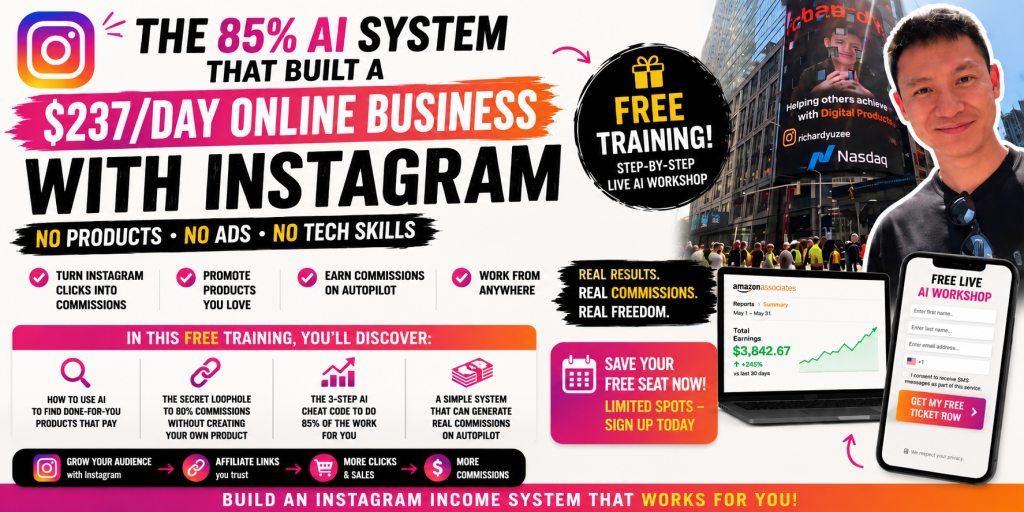
Save your spot now, then keep reading for the complete guide to making money with digital products.
Why Digital Products Work Better Than Almost Any Other Beginner Income Model
Before we get into the how, the why is worth understanding clearly.
Every physical product business has what you could call a fulfillment cost. Time, materials, shipping, storage, and the human labor required to move something from production to a buyer’s hands. These costs exist whether you are selling one unit or a thousand.
Digital products have no fulfillment cost beyond the initial creation. The file you upload today sells to one person or ten thousand people with identical effort on your end. The marginal cost of each additional sale is essentially zero.
That is the core mathematical advantage that makes digital products so compelling as an income model.
The other advantage is permanence. A well-positioned digital product continues selling for months and years after it is created. The work you do today compounds indefinitely. That is the definition of building an asset rather than just generating transactions.
Step 1: Find the Right Product Idea
The most common beginner mistake is creating a product based on what you enjoy making rather than what people are already spending money on.
Spend 30 minutes on Etsy before you build anything. Search your general topic area and filter results by bestsellers. If multiple shops have hundreds of sales and detailed buyer reviews in a category, you have found validated demand.
Your job is to create a version that serves that demand more specifically, more clearly, or more usefully than what already exists.
Read the one and two star reviews on competing products. The complaints and unfulfilled expectations in those reviews are your product development roadmap.
Build the version that solves what others failed to deliver.
The digital product categories with the most consistent demand include budget and finance templates, meal planning tools, social media content kits, productivity planners, parenting guides, beginner business resources, and niche-specific ebooks.
The rule is always the same: solve one specific problem for one specific type of person.
Step 2: Build It Lean and Build It Fast

Perfectionism is the single biggest threat to a digital product business.
Creators who spend three months building the most comprehensive resource ever made and then launch to an audience of zero will always be outearned by someone who built something genuinely useful in a week and started collecting real buyer feedback immediately.
Your first product should solve one problem clearly. It should be built in days, not months. And it should be priced to sell, not to impress.
AI has collapsed the production timeline for digital products dramatically. Use it to outline your product structure, draft the written content, write the product description, and generate the promotional copy.
What used to require significant writing skill and creative energy now takes an afternoon with the right tools.
For design, Canva handles templates, planners, ebooks, and printable guides at a professional level with no prior design experience needed.
For written content, AI drafts the structure and copy and you add your personal knowledge and voice to make it genuinely useful and authentic.
Build lean. Get it live. Let real sales data tell you what to refine.
Step 3: Price It With Confidence
Most beginners underprice out of fear. That fear costs them more than they realize.
To earn $1,000 from a $5 product you need 200 sales. To earn the same $1,000 from a $37 product you need 28 sales. To earn it from a $97 product you need 11 sales.
The lower the price the more traffic you need to generate the same revenue and the harder the overall business becomes.
Beyond the math, price signals quality. A $7 ebook feels disposable. A $37 ebook feels like an investment worth opening and acting on.
Research what comparable products in your niche sell for and price in the mid to upper range of that window.
Confidence in your pricing communicates confidence in your product.
Step 4: Choose the Right Platform

For beginners with no existing audience, start on a marketplace like Etsy or Gumroad.
Etsy brings built-in buyer traffic.
Gumroad is the fastest platform to get a product live and collecting payments, often in under an hour.
As you build an audience through content, add a direct storefront like Stan Store or Payhip that integrates with Instagram and collects buyer email addresses alongside purchases.
Owning your customer list is the most valuable long-term asset in any digital product business.
The platform decision is not permanent. Start where the friction is lowest and migrate as your traffic grows.
Step 5: Solve the Traffic Problem
Here is the honest truth that the reference article, and most digital product guides, barely address.
A great product on the wrong platform with no traffic earns nothing. Traffic is the business. Everything else is preparation. The digital product sellers generating consistent passive income are not necessarily the ones with the best products.
They are the ones who built a content system that consistently puts their products in front of people actively looking to buy.
Instagram and Pinterest are the two most powerful free traffic platforms for digital product sellers right now. Both reward evergreen content that continues driving clicks and sales long after it is published.
Both have audiences in active buying mode. And both become dramatically more manageable when AI handles the content creation that most beginners do not have time for.
AI writes your Instagram captions, generates your Pinterest pin descriptions, creates your story sequences, and helps you produce weeks of promotional content in a single focused session.
The traffic flows. The product sells. The income compounds in the background.
This is the piece that transforms a digital product from a file on a server into a genuine passive income stream. And it is exactly what Richard walks through in his free masterclass.
Making money with digital products comes down to three things: the right product, the right platform, and the right traffic system. Richard shows you how to build the third one, the one most people never figure out on their own.
👉 Access Richard’s free masterclass HERE
Register now, work through it at your own pace, and walk away with a complete action plan covering not just how to create digital products but exactly how to drive the consistent traffic that turns them into passive income.
Your first digital product sale is closer than you think. Your first consistent month of digital product income starts with the right traffic system. Come get it.
This post contains affiliate links. I may earn a commission if you register through my link, at no extra cost to you.