Stripe wants you to register your business, build a website, and set up payment processing before you make a single dollar. Here is why that sequence works against beginners and what to do instead.
The standard advice for how to start an online business reads like a corporate checklist.
Register your business entity. File the necessary paperwork. Build a professional website. Set up payment processing. Develop your brand identity. Create a marketing strategy.
Then, finally, start trying to earn money.
That sequence makes sense for someone launching a funded startup or opening a physical storefront.
For a beginner who wants to build an online income from scratch, it is the longest possible path between where you are right now and your first dollar earned.
It front-loads every administrative and technical task before the one thing that actually tells you whether your business idea works:
Getting a real person to pay you for something of genuine value.
Starting an online business in 2026 does not require a registered LLC, a custom website, or a Stripe merchant account before you make your first sale.
It requires a validated offer, a platform to distribute it through, and a content system that consistently puts that offer in front of people who want it.
Everything else comes after you have proven the model works.
Before we walk through exactly how to build that, my mentor Richard Yu has put together a free masterclass that shows how complete beginners are starting online businesses using AI and Instagram, generating real income without the months of setup that traditional business advice demands.
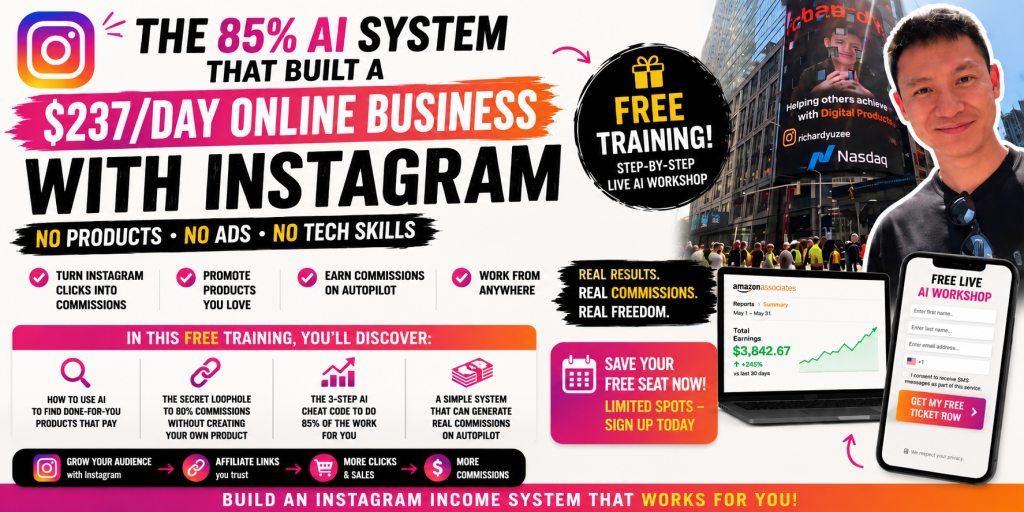
👉 Get free access HERE
Save your spot now, then read through the complete guide below.
The Order That Actually Works for Online Business Beginners
Traditional business advice builds infrastructure first and finds customers second. That sequence works when you have funding, a team, and time to invest before revenue arrives.
The sequence that works for beginners building an online business from zero is the opposite. Validate first. Build infrastructure only after you have proof that people will pay.
Here is what that looks like in practice.
Phase One: Choose a Model That Requires No Upfront Investment

The online business models that work fastest for beginners share one characteristic: they do not require you to create and fund inventory, a platform, or a team before generating your first dollar.
High-ticket affiliate marketing requires nothing but a phone, an internet connection, and the willingness to create consistent content around a specific niche. You recommend other people’s products and earn commissions when your audience buys through your link.
Zero startup cost. Zero inventory. Zero customer service obligation.
The income is real from the first qualified conversion.
Selling digital products requires the time to build something once. A guide, a template, a planner, a mini-course. After that first build, the product sells indefinitely with no further production cost.
Gumroad and Etsy handle the payment processing and delivery. You do not need your own website, your own LLC, or your own merchant account to make your first ten sales.
Freelance services require only the skill and the outreach to find your first client. Copywriting, social media management, virtual assistance, and consulting all generate income from a direct client relationship with no infrastructure required beyond a way to communicate and collect payment.
Start with one of these three. Prove that people will pay you. Then build the infrastructure that supports scaling what you have already validated.
Phase Two: Build Your Distribution System

Every online business needs a way to consistently put its offer in front of the right people. Without distribution, the best offer in the world earns nothing.
Instagram is the most effective free distribution platform for online business beginners right now for three specific reasons.
The algorithm surfaces content to non-followers based on topic and engagement, which means a brand new account can reach thousands of potential customers without an existing audience. The link in bio creates a direct, frictionless path from content to conversion.
And AI tools have made the content creation required to maintain a consistent Instagram presence manageable for a single person running a business alone.
AI writes your captions. AI generates your content angles. AI scripts your Reels and drafts your Story sequences.
The distribution system that used to require a social media team now requires one person with the right workflow and 30 to 60 focused minutes per day.
Pinterest is the second most effective free distribution channel for online businesses selling digital products or content.
Unlike Instagram, Pinterest content earns traffic for months or years after it is published because it functions as a visual search engine rather than a social feed.
The two platforms work together more effectively than either works alone.
Phase Three: Create the Conversion System

Distribution brings people to your offer. Your conversion system turns those people into buyers.
For affiliate marketing, this means a clear bio that communicates exactly who you help and what problem you solve, a single link pointing to your highest-converting affiliate offer, and content that builds genuine trust with your audience before making any recommendation.
For digital products, this means a product listing or storefront that communicates the specific outcome the buyer receives, social proof from early buyers, and promotional content that speaks directly to the problem your product solves rather than describing the product’s features.
For services, this means a portfolio or body of work that demonstrates your capability, testimonials from early clients, and a simple intake process that removes friction between interested prospect and paid engagement.
Phase Four: Register and Scale What Works

Once you have validated that people will pay for your offer and your distribution system is generating consistent inbound interest, then you register your business entity, open a dedicated business bank account, and build the infrastructure that supports sustainable growth.
Not before. After. When you know what you are building is worth building.
This sequence saves most beginners three to six months of administrative work and startup costs on a business model they have not yet confirmed will generate income.
The Gap Between Knowing and Starting
Understanding the sequence is not the same as executing it. The gap between “I know what to do” and “I am doing it consistently enough to see results” is where most online business attempts end.
The people who close that gap quickly are almost never the most technically capable or the most creative.
They are the people who found a specific, proven system and learned it from someone who had already used it to build what they are trying to build.
Richard’s free masterclass is that system, specifically for the AI-powered Instagram online business model that sits at the top of this guide.
You will see the exact content workflow, the affiliate offer selection process, the conversion system setup, and the day-by-day action plan that takes a complete beginner from zero to a functioning online business without months of administrative setup preceding the first dollar.
Starting an online business does not require a business plan, a website, or a registered entity. It requires a validated offer, a distribution system, and someone who has already built it showing you how.
👉 Access Richard’s free masterclass HERE
Register now, work through it at your own pace, and walk away with the exact starting sequence that gets you from idea to income without the bureaucratic detour that stops most beginners before they ever begin.
This post contains affiliate links. I may earn a commission if you register through my link, at no extra cost to you.