Canva is more than a design tool. For beginners who know how to use it strategically, it is a complete income-generating system. Here is exactly how to make that work.
Most articles about making money with Canva tell you the same thing.
Create some templates. Upload them to Etsy. Wait for sales.
That advice is not wrong…
Canva templates sell consistently on Etsy and there is real income to be made from that model.
But it is one narrow slice of what Canva actually makes possible for people who want to build real online income.
Canva is not just a template-creation tool. It is the production layer that sits underneath almost every visual online income model that exists right now.
- Social media content.
- Digital products.
- Affiliate marketing graphics.
- Pin designs for Pinterest.
- Instagram carousels.
- Lead magnets.
- Mini-courses.
- Brand kits for clients.
Everything that requires a visual gets built faster, better, and more professionally in Canva than in almost any other tool available to beginners.
When you understand that, the income possibilities expand dramatically beyond a shop listing on Etsy.
Before we break it all down, my mentor Richard Yu has put together a free masterclass that shows exactly how people are using AI alongside tools like Canva to build real income on Instagram from scratch.
No design background required. No prior experience needed.
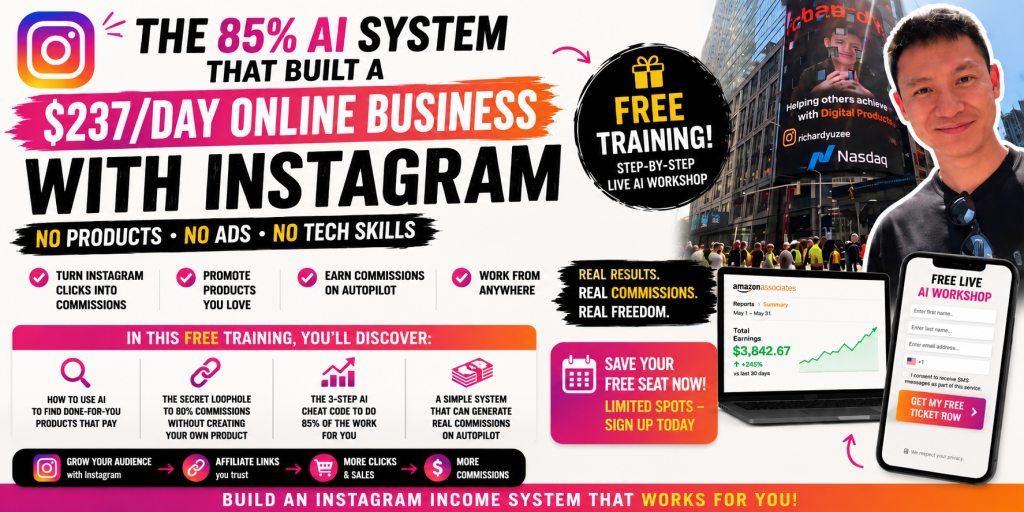
Save your spot now, then keep reading for the complete guide to making money with Canva.
Why Canva Has Changed What Is Possible for Beginners
Before Canva, creating professional-quality visual content required either expensive software, formal design training, or the budget to hire a graphic designer.
All three of those put high-quality visual content out of reach for most beginners trying to build an online income.
Canva changed that entirely.
The free version alone covers the majority of what most online income builders need.
The Pro version unlocks premium elements, brand kits, background removal, and thousands of additional templates that make professional output achievable in minutes rather than hours.
For beginners, this matters because visual content is no longer optional in any serious online income model.
Instagram requires compelling visuals. Pinterest is built entirely around images. Digital products need professional-looking design to command premium prices. Client deliverables need polish that signals expertise before anyone pays for anything.
Canva makes all of that achievable without a design degree, a creative team, or an Adobe subscription. And AI makes it faster and more strategic than ever before.
The Ways to Actually Make Money With Canva

1. Selling Canva Templates as Digital Products
This is the most commonly discussed Canva income model and for good reason.
Canva templates sell consistently across Etsy, Gumroad, and Payhip because buyers want professional designs they can customize without starting from scratch.
The template categories with the strongest consistent demand include Instagram post and story templates, Pinterest pin templates, business brand kits, resume and portfolio templates, presentation decks, social media content calendars, and planner and journal pages.
The key to succeeding in this space is specificity. Generic Instagram templates compete with thousands of listings.
Instagram templates specifically designed for life coaches in their first year of business compete with almost none.
The more specific your template pack, the less competition you face and the higher the price you can command.
AI helps you research which template categories have the most validated demand, write your product descriptions, and generate the promotional content that drives buyers to your listings.
Canva builds the templates. AI markets them. You collect the passive income.
2. Using Canva to Build and Sell Other Digital Products

Templates are just one category of digital product you can build in Canva. Ebooks, workbooks, guides, planners, printable journals, budget trackers, habit trackers, meal planners, and educational resources are all created entirely within Canva and sold as PDF downloads.
The advantage here is that Canva’s professional output makes even a simple guide or planner look polished enough to charge real money for.
A budget planner built in Canva and priced at $27 earns the same as a $27 template pack but serves an entirely different buyer who is not looking for a design resource at all.
AI creates the content. Canva creates the design. You upload it once and sell it indefinitely.
3. Offering Canva-Based Freelance Services
Businesses and personal brands pay consistently for social media graphics, brand kits, presentation decks, and marketing materials.
If you can deliver professional-looking Canva designs reliably and on time, there is a genuine freelance market waiting for you.
The fastest way to land freelance Canva work is to build a portfolio of 10 to 15 strong sample designs across the categories you want to offer, post them consistently on Instagram, and make it clear in your bio exactly what you provide and for whom.
AI helps you draft the outreach messages, write the service descriptions, and create the Instagram content that attracts potential clients before they ever have to find you through cold searching.
4. Creating Instagram Content That Drives Affiliate Commissions

This is the income model most Canva guides never mention, and it is the one with the highest ceiling for people starting from zero.
Canva powers the visual content. Instagram distributes it. Affiliate marketing monetizes it.
The three work together as a system that generates income without you creating a product, handling customer service, or managing any delivery.
You use Canva to design your Instagram carousels, quote graphics, and educational posts. AI writes the captions and generates the content angles.
You post consistently around a specific niche and embed affiliate recommendations naturally into your content.
When the right people find your posts and take action through your affiliate links, you earn commissions, typically $200 to $1,000 per sale from high-ticket programs.
This is the model that scales most dramatically over time because the content library you build in Canva keeps working long after you publish it.
Posts from six months ago continue driving affiliate traffic and commissions without any additional effort.
5. Social Media Management for Clients

If you can design consistent, professional social media content in Canva, small businesses will pay you monthly to do exactly that for them.
Social media management is a recurring income model. One client at $700 to $1,500 per month. Two clients. Three. Canva handles the design.
AI writes the captions. You manage the strategy and client relationships. The income is predictable, the work is remote, and your efficiency improves significantly as your Canva workflow becomes more systematized over time.
The Part That Makes All of This Actually Work
Canva solves the visual production problem. It does not solve the traffic and distribution problem.
Every income model above depends on getting the right people to see what you have made.
Etsy provides some built-in marketplace traffic. Freelance services require client acquisition. Affiliate marketing and social media management both require a consistent content strategy that attracts and converts an audience over time.
That is where most Canva income builders stall. They can design beautifully. They have no system for getting their designs in front of buyers consistently without burning out or spending money on ads.
Instagram, powered by AI-generated content, is the distribution system that solves this problem for beginners.
It is free. It is fast. It rewards consistency over budget.
And the combination of Canva visuals, AI-written copy, and a clear affiliate or product offer is the complete income system that Richard walks through in his free masterclass.
Canva gives you the production tool. AI gives you the content engine. Richard shows you how to connect them to a system that actually earns.
👉 Access Richard’s free masterclass HERE
Register now, work through it at your own pace, and walk away with a complete system for turning your Canva skills into consistent online income.
Making money with Canva is not just about selling templates. It is about using Canva as the visual layer of a complete income system. That system is waiting for you right now.
This post contains affiliate links. I may earn a commission if you register through my link, at no extra cost to you.